Monday, January 20, 2014

The Lowrider of Tables: Japanese Low Table Part 1: Making a Plan

A Plan Hatches: In which I decide to build a Japanese low table.

Japanese traditional furniture. Picture a traditional Japanese room, the kind with the tatami floor and all the cool, clean lines.

Not a lot of furniture? Well, traditionally, if you need something, you can pull it out. Space is a premium, and you need to think outside the box that you live in. Your living room can also be your dining room and bedroom. It can be anything! (Except a bathroom- that's the rules, man.)

You can add futons. Easy to drag out.
In the morning, pack them away and you can bring out a table.
Not to say that all Japanese houses consist of one room, but I think I'm pointing out how darn practical Japanese furniture can be. And how much I like those low tables. We had a low table in the last trip at Koya-san in the monastery.
I think to myself- no way I can buy furniture in Japan and stuff it in my suitcase. And no way I'm paying crazy shipping either. Solution: make a table.
To start, I wanted to see what variety there is. I quickly learned that there are distinctions between standard low tables like this that can be desk/dining table/coffee table and other types of tables.
You're probably familiar with kotatsu.
Kotatsu
The major difference here is the fact that it's made to hold a flat heater unit insulated with a thick comforter between frame and tabletop. Heavenly for wintery places! Like, not Florida places. Next:

Chabudai
Translation: tea table. Cool. Looks similar to a regular Japanese low table, except...they're mostly round. And kinda intended for tea. Okay, round it nice and all, but I just want a standard grade A table.

Te-buru
I can't find the name of a this. It is just "table"? I know the name of the cushions one sits on at such a table (zabuton), but what about the table itself? The important thing is I know what it looks like.
And I know what it feels like. And I can measure how tall it needs to be to fit over my American thighs. I can personalize it with shelves. I can pick out the wood I want. I can build it, too, because I have an expert wood craftsman on staff, aka "Dad".

The Plan
Here's my Sketchup mockup:
Now to pick out wood! There's a wood warehouse place in town. Lots of varieties, and it looks like a lot of exotic wood if from Africa, and does not have a Japanese vibe. The teak looks very nice, and is the only Asian wood in the place. I would jump on that if it weren't for the fact that it's $17 a board foot. Okay, so I narrowed it down to:
Mahogany, below
Walnut, above. I went back and forth. Both hardwoods, good for furniture. Mahogany is a little cheaper. Walnut has a pretty dusky brown color. Mahogany is reddish. I decided to go for mahogany. Maybe it was that little girl in me that remembers all the pretty mahogany furniture in historic houses I've seen. Maybe I was afraid the dusky brown Walnut would look too dull in a bright carpeted room. I dunno. We'll see how it turns out. Tune in later as this thing gets off the ground. (But only by 12 inches.)

Saturday, January 11, 2014

Oh! Onigiri: Riceballs of Sticky Goodness


Sushi is good times and all, but I'm just as happy with a nice, satisfyingly triangular onigiri.
That's onigiri, not to be confused with nigiri. And certainly not to be confused with oni.

Nigiri:

Oni:

Onigiri:
Onigiri can have so much variety.
And comes in such a beautiful, hand-held better-than-a-sandwich level of convenience. And they're pretty cheap, too. And really filling. I love looking at the rows of conbini onigiri.
This one was in Osaka. In Tokyo Station, there's a whole store of onigiri!! Anyway, needless to say I have to try it out.
Here's a handy little illustration of the homemade process, just like grandma and her cat make:
Okay! We start with making rice. I used sushi rice, because, well, I don't know, what do I know? Seems like a good idea. You may have seen the Japanese method before, where you rinse the rice till the water is clear. One website says rinse 2 or 3 times, which was complete bullcrap. Maybe more like 2 or 3 minutes, and it still looks a slightly cloudy. Whatever. Good enough.

Then you dump in water with the rice in a pot, and 25 minutes later, it's done. Yay! Sticky rice! I'm not adding rice vinegar, because this is not sushi. But it's a million degrees steamy hot, and this activity uses your hands to shape the rice balls. Okay, so let's check on the filling part.
Last Japan trip, my favorite was the pickled mustard greens・高菜(takana).

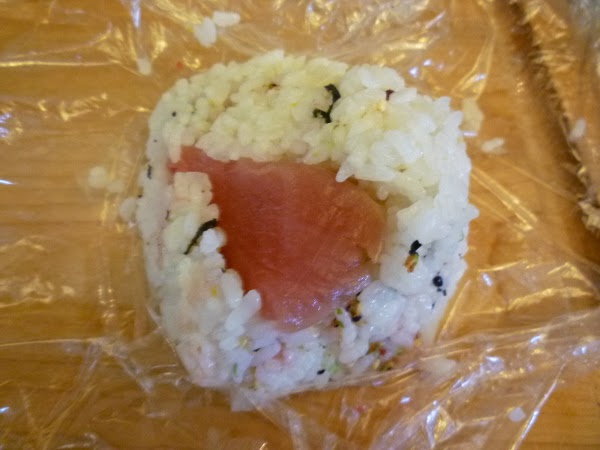
 I found some pickled mustard greens at my favorite local Asian foodstuff store. Fresh Market had sashimi tuna steaks on sale for $5. Why not? And then there's pickled plum, because it's not Japanese until Pickled Plum comes to the party.


I clearly should have done as the grandma picture indicated and had a bowl of water and used wet hands to shape the balls. I had sticky grains of rice clinging to me like crazy and that was with using plastic wrap overtop. Also...triangles are harder than you think.

I was making progress, though. I think you have to make "L" shapes with your hands.

So, lessons learned: Use a bowl of water, no plastic wrap. Sashimi is nice and all, but what you need for onigiri is shredded style- easier to bite. Also, save the nori wrap till you're ready to eat, so it'll be nice and crisp. And this stuff takes a lot of rice. 1 cup dry rice yielded 4 onigiri of moderate size.

Next time: I'm going to try the baked/yaki onigiri. Oooooh.


 Here's some more onigiri from my trip:


Sunday, December 22, 2013

Japanese Eggnog: Festive Drink or Sickness Remedy?

For me December 2013 has been a time of sore throats and coughing that has developed into a very special Holiday Bronchitis. There is no cure for Holiday Bronchitis, but there are treatments. Sure, NyQuil and Tussin and cough drops maybe, but my favorite is eating my way through my Japanese ramen supply:
 
Salt Flavored Ramen with Yuba
Add an egg. Do it.


Tempura Ramen


 Good stuff for a sore throat. What else can Japan offer to ease the Holiday Bronchitis?


Tea. Looking up Japanese folk cures will result in Japanese Ginger and Lemon Tea.  AKA Shoga Yu.


Which is great, but so completely universal, it's not exactly a Japan exclusive. It's been in use in Western medicine for a while. In fact, my money is on China for being the originator. But seriously, it's not bad to try this stuff if you're sick. Warm and zingy.  But for the love of Pete, strain your ginger out.

Back to the post title theme. The other sick remedy you'll bump into when looking for Japanese folk wisdom is Tamago Zake or Egg Sake or some translations say Eggnog.
Okay, this looks doable, and even though I only have the dregs of Holiday Bronchitis left, I am all about Eggnog. Full disclosure: there are 2 different types of Eggnog in my fridge, and I plan to make a 3rd for Christmas Eve involving almond milk. This will be a 4th if you count it as real Eggnog.

Taking a look at Cookpad, it looks like the traditional way is indeed egg, sugar, and sake.
Here's one recipe.

Fuwa Fuwa=fluffy
2 methods, 1 for kids


 And this is another.


It looks like if you want it to be "creamy" and/or kid-friendly, add milk in place of some of the sake. I'm going to try the traditional way. I have enough milk-based Eggnog to last me till...well, shortly after Christmas probably, but anyway, I want to try this sake-based version the traditional way.
Looks like this guy had some issues with high heat and eggs scrambling:

So I've got to be careful. Here I go!
Ingredients

OK, stir the heck out of 1 egg, add 2/3 cup sake and like almost 2 Tablespoons of sugar. Turn on the heat to lower-is-better. Stir always, stir well. That's why I went with a whisk instead of cooking chopsticks. It gets all foamy. Good.

Whhhhisk
Then it gets a little bit steamy and I notice it's slightly thicker. Good. Then I hear the Ima-bout-to-boil rushing sound, and then sure enough little boil bubbles appear, and they seem to chase away the eggy foam. I wait a few more moments to make sure it has boiled through everywhere, then I take it off, still stirring.
Hmm...definitely thicker, but...
Into a mug.
Oops.
Well, it was promising, but it turned out slightly broken. Mayhaps I should have taken it off once I heard the sound of the almost-boiling. It was a little thicker in parts and thin in others like pudding with puddles. Not a bad idea for a sore throat with the alcohol heat in your throat and the soothing creaminess. Or just something to build up energy if nothing else. Probably not so great if you're nauseous. But perfect for Warm Holiday Cheer.

Sunday, December 1, 2013

Shinsaibashi-suji: It's like a mall, but you can get run over

It seems like there are many malls in Japan that follow the old fashioned format of one long, narrow walkway with a tall arched roof. We saw Nishiki Market in Kyoto is like this.
Nishiki Market
And that other place from the 2011 trip. The Nakano Broadway shopping arcade?
Me in Nakano Broadway Shopping Arcade
This time around we went to Osaka for the last day to be closer to the airport, and it was an easy walk to get to the big shipping arcade that apparently, according to Wikipedia, has been around since the 1600s. Shinsaibashi-suji. But back then, there was no fro-yo, so there were significantly less visitors. I made a crappy video to give you/me the idea of the inside/outside effect.

Saturday, November 30, 2013

Wafer Thin: Wafer Chocolate and Cookies in Japan


I will confess I like Japanese KitKats. Kinda obsessed. You hear good things- better ingredients, variety of flavors, even some that are exotic, created by a master patissier (Takagi).


And I look out for Kit Kats when I’m in Japan. Apart from milk chocolate and "adult" otona dark, they are harder to find than you’d think. (Although I found the most varieties together at Narita airport.)


So what I’m saying is there’s good things to be said about putting together some wafers and chocolate. I found a few other wafery things to try. 


Wafer 1: Fujiyama Home Pie


These things looked promising…and even a no-kanji reader like me can tell these things are both chocolaty and wafery (and clearly not pie), but they were the croutons of the wafer world. A hard crunch with a very light chocolate taste, like they just spritzed a layer of chocolate-flavored lacquer on. Okay for a snacky munch attack, but not memorable.


Wafer 2: Cara-Mate


I don’t know if these guys are related to Calorie Mate, possibly the most boring-yet-popular food in Japan.

But it looks a heck of a lot yummier. And who doesn’t like the smooth mellow taste of caramel? It’s probably a caramel palm kernel oil, and I wish I could read the ingredients to find out…

But it’s good stuff. 6 individual bites, lots of wafery crunch with a clear caramel flavor. The caramel layer is nice and thick. This I could get again. It’s a good Kit Kat-like-but-different product.
 Wafer 3: Not a Wafer?

Well, it certainly looked like a wafer to me…waffled shape and all. And I didn’t read it till I took it home- it says “senbei”. As in those soy-sauce glazed crackers. Ack, what the heck is this? It was clearly in a dessert counter at the foody mall part of Tokyo station. So it turns out to be more of a thin Milano-like cookie with whipped plain frosting sandwiched in. So…actually light and yummy, but not as wafery as I hoped.


Wafer 4: Kit Kat

Then there is the original, the star, Kit Kat. In its Japanese form. 3 mini 2-bar hits. And this one was just the plain milk chocolate variety (I’ll look at the complete range I have horded later). Elegant little bites of airy light wafer with sweet creamy chocolaty enrobed over top. Smaller than the American form, but I like the daintiness.